

Table of Contents
Process Addiction Treatment: Your Path to Healing
Process addiction treatment addresses behavioral addictions such as gambling, gaming, and compulsive behaviors through structured outpatient care that targets the underlying patterns of compulsion. At Rosewood Recovery, we deliver individualized, evidence-based addiction treatment for adults, licensed by the Pennsylvania Department of Drug and Alcohol Programs (DDAP) and the Office of Mental Health and Substance Abuse Services (OMHSAS) and accredited by The Joint Commission. Our holistic approach integrates clinical therapies with somatic and wellness practices to heal the whole person.
Our outpatient services offer a continuum of care: The Partial Hospitalization Program (PHP) provides a high level of structure, the Intensive Outpatient Program (IOP) offers flexibility, and the General Outpatient Program (OP) provides long-term support and integration of treatment into everyday life. Our financial and insurance teams help remove financial barriers to treatment, and our admissions team is available to provide benefits verification and assist with treatment planning.
Sustainable healing rests on embracing the core recovery principles, including the Three C’s, a framework that empowers individuals to reclaim autonomy over their lives. Recovery Begins Here.
Core Principles of Addiction Recovery: The Three C’s
Recovery from addictive behaviors rests on universal principles that guide every step forward. At Rosewood Recovery, we believe understanding these core concepts illuminates the path to lasting wellness. The Three C’s, Choice, Change, and Consequences, provide a foundational framework for individuals in Pennsylvania seeking to reclaim their lives.
Choice is the critical moment when a person voluntarily decides to seek help and take ownership of their recovery. It transforms hope into action. We honor this starting point by creating a welcoming, non-judgmental environment where every client feels empowered to begin their unique path.
Change gains momentum through structured, evidence-based care. In our Partial Hospitalization Program, clients engage in over 20 hours of weekly therapeutic programming, participating in individual therapy, group sessions, and holistic modalities such as yoga and mindfulness. This intensive model, grounded in proven approaches like Cognitive Behavioral Therapy and Dialectical Behavior Therapy, helps break old patterns and build healthier coping strategies. This level of care typically spans four to eight weeks, allowing for deep, transformative work.
Consequences involve developing a clear understanding of addiction’s impact on relationships, physical health, and emotional well-being. Our integrated approach addresses co-occurring conditions such as trauma, anxiety, and depression, healing the underlying wounds that fuel addictive behaviors. Through a blend of clinical therapies and somatic practices like EMDR, we guide clients toward meaningful self-awareness and lasting change. In our supportive setting, clients examine these consequences without judgment, allowing them to break free from shame and rebuild a life aligned with their deepest values.
These principles weave through our entire continuum of care, from Partial Hospitalization to Intensive Outpatient and General Outpatient services. Our model includes group therapy, individual counseling, and holistic methods such as yoga and mindfulness to support transformation across mind, body, and spirit. All programs operate under licensure from the Pennsylvania DDAP and OMHSAS and accreditation by The Joint Commission, ensuring the highest standards of clinical quality and accountability.
By embracing Choice, Change, and Consequences, we help each client build a solid foundation for sustainable recovery. These principles empower individuals to move forward with clarity and confidence, ready to engage in the structured steps that lead toward a brighter future. If you or a loved one is ready to begin your journey towards happiness and freedom, our team is here to offer compassionate, professional guidance every step of the way.
The Five Steps of Successful Addiction Treatment
At Rosewood Recovery, we use an evidence-based, five-step framework to help each client move through the recovery process in a structured way, from the initial acknowledgement of their problem to sustained sobriety.
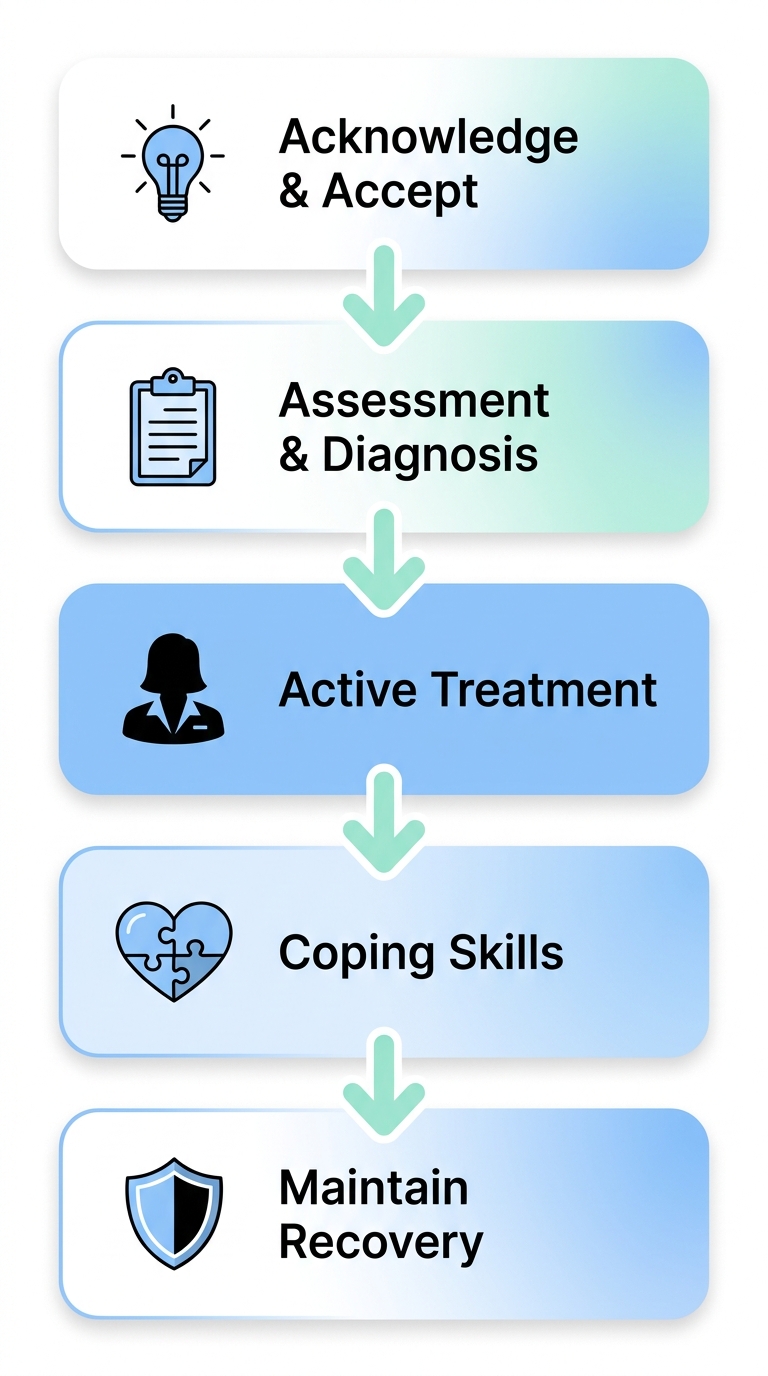
Acknowledgment and Acceptance
Recognizing and acknowledging a problem with addiction is the starting point for the recovery process and the acceptance of the need for professional help is integral to the success of any recovery program. Our admissions team listens without judgment to clients and their families, helping them understand that addiction is a treatable condition. During this process, they begin to address and work through fears, build motivation, and create a recovery-oriented environment.
Professional Assessment and Diagnosis
In order to provide the right level of care and treatment, a detailed and comprehensive psychiatric and substance use disorder evaluation is necessary to review medical history, psychosocial factors, and individual readiness for change so treatment can be matched to clinical need. At Rosewood Recovery, our licensed clinicians use ASAM criteria to assess the severity of a potential client’s substance use disorder and assess for the presence of any co-occurring mental health conditions.
Active Treatment and Therapeutic Intervention
Our Partial Hospitalization Program (PHP) provides 20 or more hours of structured treatment per week across 5 to 7 days, and our Intensive Outpatient Program (IOP) offers 9 to 15 hours per week in 2- to 3-hour blocks. Our General Outpatient Program (OP) provides a lesser, but ongoing, structured treatment offering to help maintain the client in recovery. Treatment is complemented by individual, group, and family counseling, as well as healing and holistic practices such as yoga and mindfulness.
Building Coping Skills and Life Integration
We emphasize skill-building through modalities such as Cognitive Behavioral Therapy (CBT) and Dialectical Behavior Therapy (DBT), including practicing relapse prevention strategies, communication skills, and healthy routines. PHP groups provide daily practice; IOP and OP focus on applying tools in real-world settings as independence grows.
Maintaining Recovery and Preventing Relapse
Prior to completion of any of our programs, our team partners with the client to create their individualized relapse prevention plan to address their triggers and build a sober support network and schedule aftercare. Our clients may also access the alumni support group at Rosewood Recovery. If you are ready to start your five-step journey, we encourage you to schedule a consult call.
The table below outlines where each of our programs at Rosewood Recovery place clients along the five steps of the recovery model.
| Recovery Step | Partial Hospitalization Program (PHP) | Intensive Outpatient Program (IOP) | General Outpatient Program (OP) |
|---|---|---|---|
| Acknowledgment and Acceptance | Compassionate intake helps clients recognize the need for structured care. | Motivational intake reinforces readiness to change. | Initial session builds recognition and readiness. |
| Professional Assessment | ASAM-based evaluation determines need for intensive day treatment. | Comprehensive assessment identifies co-occurring disorders and severity. | Evaluation confirms stability for less structured care. |
| Active Treatment | 20+ hours per week, 5–7 days. | 9–15 hours per week, 2–3 hour sessions. | Weekly sessions at lower intensity. |
| Building Coping Skills | Daily groups and experiential therapy build stress-management skills. | Structured skill sessions on relapse prevention and triggers. | Targeted sessions reinforce coping in daily life. |
| Maintaining Recovery | Detailed discharge plan and alumni support access. | Gradual step-down plan with relapse-prevention planning. | Ongoing therapy and alumni group connection. |
Outlining the programs in this way clearly shows that, no matter where you start, Rosewood Recovery can match clients with a program that supports their current needs and long-term goals.
Finding the Most Effective Treatment for Process Addiction
Effective care for process addictions relies on a combination of evidence-based psychological therapies, holistic practices, and a well-structured treatment pathway. Unlike substance use disorders, compulsive behaviors like gambling, gaming, or internet use demand therapeutic strategies that target the underlying thought patterns and emotional triggers fueling the cycle.
Evidence-Based Therapies That Drive Recovery
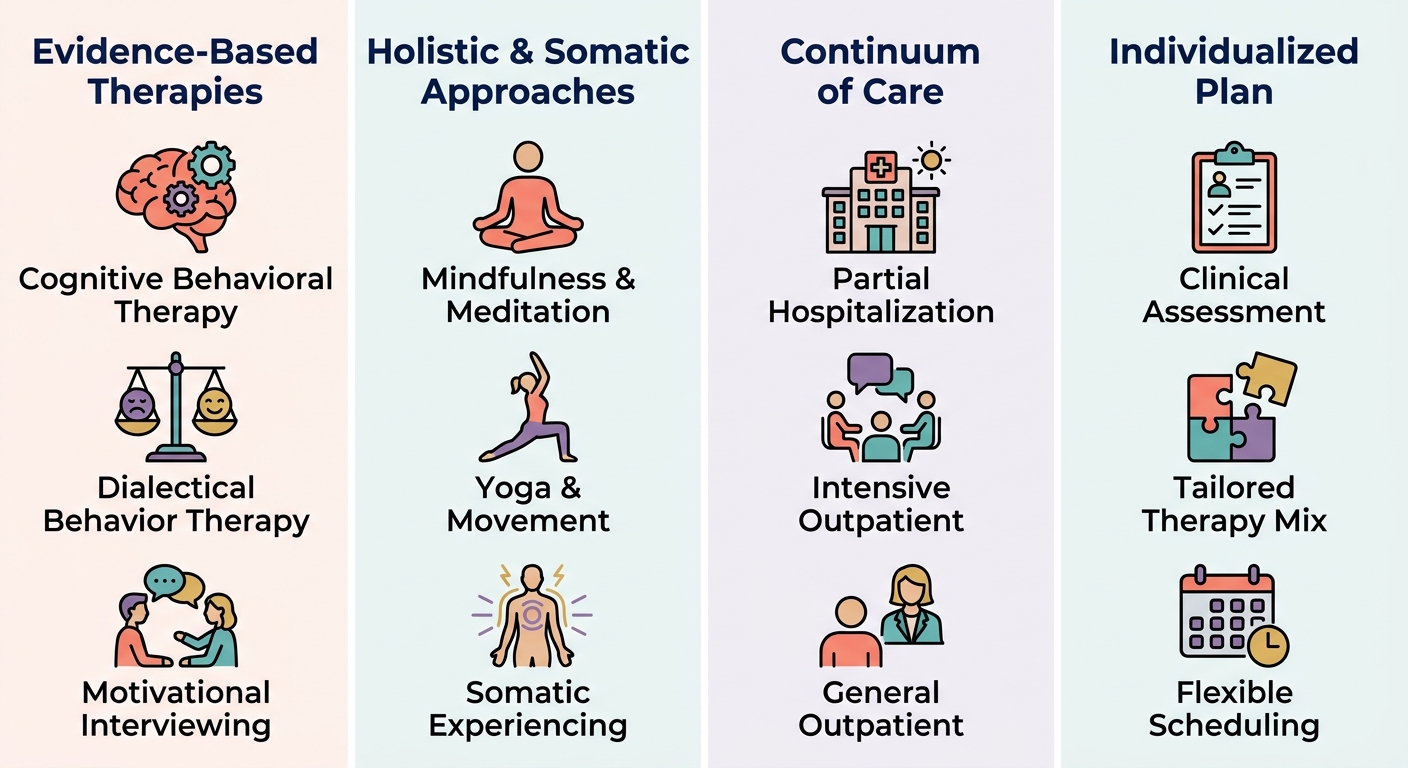
Cognitive-behavioral therapy (CBT) addresses the distorted thinking that sustains behavioral addiction treatment. Dialectical behavior therapy (DBT) builds on this by teaching concrete skills for emotional regulation and distress tolerance. Motivational interviewing strengthens a person’s internal readiness to change by exploring ambivalence.
Holistic and Somatic Approaches to Healing
Where traditional therapies focus on thoughts and behaviors, holistic and somatic methods address the physical and emotional residue of addiction stored in the body. Mindfulness practices train individuals to observe cravings without automatically acting on them, reducing reactivity. Yoga combines breathwork with movement to regulate the nervous system, while somatic experiencing releases trauma-related tension that may underpin compulsive patterns.
Integrating both dimensions strengthens recovery by treating the whole person.
The table below highlights how traditional behavioral therapies and holistic approaches differ while working toward shared recovery goals.
| Therapy Type | Cognitive-Behavioral Therapy (CBT) | Dialectical Behavior Therapy (DBT) | Holistic & Somatic Therapy |
|---|---|---|---|
| Primary Focus | Distorted thought patterns and beliefs | Emotional dysregulation and interpersonal skills | Mind-body connection and stored trauma |
| Key Techniques | Cognitive restructuring, behavioral experiments | Distress tolerance, dialectical strategies | Mindfulness, yoga, somatic experiencing |
| Treatment Goals | Skill building and cognitive flexibility | Emotional regulation and relationship stability | Stress reduction and trauma release |
| Typical Session Activities | Structured talk therapy and thought records | Skills groups and diary cards | Experiential exercises and breathwork |
These approaches serve different but complementary functions in treatment for process addiction in Pennsylvania. CBT and DBT provide the cognitive and emotional scaffolding, while holistic methods offer physiological regulation that supports those gains.
The Role of a Continuum of Care
A seamless care continuum allows individuals to step down gradually from higher to lower intensity services as their stability improves. At Rosewood Recovery, a Partial Hospitalization Program (PHP) provides 20 to 30 hours of weekly therapy across four to six hours each day, creating a highly structured environment for those needing significant clinical support. An Intensive Outpatient Program (IOP) delivers nine to fifteen hours per week over two to three-hour sessions, offering flexibility for those resuming work or family responsibilities.
This graduated approach follows ASAM criteria for placement, ensuring individuals receive neither more nor less treatment than their clinical presentation requires.
Creating an Individualized Treatment Plan
No single therapy or program structure works universally, which is why treatment begins with a thorough clinical assessment. Licensed professionals at facilities like Rosewood Recovery evaluate co-occurring mental health conditions, personal history, and practical constraints to build a plan that fits the individual.
An individualized plan that integrates evidence-based and holistic therapies creates a foundation for more advanced strategies that support lasting recovery.
We are ready to help you understand your options and find the right starting point. Call us at (267) 651-4817 or visit our location at 140 Terry Dr Suite 118, Newtown, PA 18940 to start your treatment.
Advanced Treatment Approaches for Lasting Recovery
Our Partial Hospitalization Program (PHP) in Newtown, Pennsylvania offers 20 hours or more of therapeutic services per week, similar to day treatment, but without the need for an overnight stay.
Our PHP is co-occurring capable and, therefore, treats substance use disorders alongside co-occurring mental health concerns such as trauma, anxiety, and depression through integrated evidence-based modalities including Cognitive Behavioral Therapy, Dialectical Behavior Therapy, and trauma-focused interventions. Rosewood Recovery is accredited by the Joint Commission and is licensed by the Pennsylvania’s Department of Drug and Alcohol Programs and the Office of Mental Health and Substance Abuse Services. Every client’s treatment plan is individualized based on comprehensive multidimensional assessments and aligned with the ASAM criteria to ensure that their individual needs and goals are reflected in their treatment plan and recovery goals.
We have a specialized track for high functioning executives and professionals to ensure that we are incorporating the demands of their career into their recovery. In addition, eligible clients can access FMLA job-protected leave for up to 12 weeks. Further, we offer flexible scheduling and discreet intake procedures to help ensure that our clients are able to maintain their professional commitments. Finally, we strive to make treatment accessible by accepting a variety of insurance plans, and offer a sliding fee scale.
Table 3: ASAM Levels of Care at Rosewood Recovery
| ASAM Level | Intensity (Hours/Week) | Ideal Client Profile | Rosewood Program |
|---|---|---|---|
| Partial Hospitalization Program (PHP) | 20+ hours per week | Adults requiring structured day treatment for substance use and co-occurring mental health conditions without 24/7 residential monitoring. | PHP at Rosewood Recovery, Newtown, PA |
| Intensive Outpatient Program (IOP) | Typically 9–12 hours per week | Individuals stepping down from PHP or needing substantial clinical support while maintaining work, school, or family responsibilities. | IOP at Rosewood Recovery |
| Outpatient Program (OP) | Variable; contact us for current schedule | Clients with a stable sobriety foundation who need ongoing accountability, coping skills, and social support. | Outpatient Program at Rosewood Recovery |
The structured continuum from PHP through outpatient care ensures that support is adjusted as recovery strengthens, reducing the risk of relapse.
Common Questions About Process Addiction Recovery
The main difference between PHP and IOP is the number of therapy hours. At Rosewood Recovery, our Partial Hospitalization Program (PHP) is 20-30 therapy hours per week (4-6 hours per day). Our Intensive Outpatient Program (IOP) offers 9-15 therapy hours per week (2-3 hours per day). Both morning and evening tracks are offered to accommodate work and family schedules.
Placement uses ASAM criteria, and enrollment requires a primary substance use diagnosis for adult clients. We treat co-occurring mental health conditions such as anxiety or depression alongside substance use disorders. For payment, we accept major insurance plans and offer a sliding scale fee structure for those experiencing financial hardship. After completing the program, our alumni support group provides ongoing connection and accountability to support long-term sobriety. Next step, our team in Newtown, Pennsylvania is ready to support your recovery journey.
Your Recovery Starts at Rosewood Recovery
Your recovery starts at Rosewood Recovery, a Joint Commission accredited treatment center located in Newtown, Pennsylvania. We offer Partial Hospitalization, Intensive Outpatient and General Outpatient programs for adults who suffer from a substance use disorder and process addiction. Our programs are customizable to fit each individual’s needs. We accept major insurance plans and offer a sliding fee scale. Call (267) 651-4817 to speak with us or visit 140 Terry Drive, Suite 118, Newtown, PA 18940. Individual results depend on many factors; the information on this site is for educational purposes only and is not medical advice. Please consult your health care professional about your personal health care. Privacy Policy and HIPAA policy are available online.
Begin Your Recovery Journey
You've explored the essential components of process addiction treatment, from core recovery principles to advanced clinical approaches. Understanding the Three C's—Choice, Change, and Consequences—and the structured steps to recovery empowers you to make informed decisions. At Rosewood Recovery, we blend evidence-based therapies like CBT and DBT with holistic, somatic practices that address the whole person. Our continuum of care, from Partial Hospitalization to Intensive Outpatient and General Outpatient programming, meets you where you are in your healing. Financial accessibility is a priority; we accept major insurance and offer a sliding scale fee to remove obstacles. Every journey is unique, and our compassionate team in Newtown, Pennsylvania creates an individualized treatment plan that respects your specific needs. Reach out to Rosewood Recovery today to schedule a confidential assessment and take the next step toward lasting sobriety.