


.png)

.png)
.png)
Table of Contents
EMDR Therapie en Trauma Verwerken in Verslavingsherstel
One powerful approach we use to address trauma in recovery is EMDR therapy. EMDR, or Eye Movement Desensitization and Reprocessing, is a structured psychotherapy that helps individuals reprocess traumatic memories. Unresolved trauma often serves as a trigger for substance use, turning drugs or alcohol into unhealthy coping mechanisms.
During EMDR sessions, a therapist uses bilateral stimulation—such as guided eye movements—while the client recalls a traumatic event. This helps the brain reprocess the memory, reducing its emotional impact. As the EMDR International Association (EMDRIA) notes, EMDR therapy is a well-researched, evidence-based treatment for trauma. For those in recovery, easing the distress of painful memories can lessen the urge to use substances as a coping mechanism. Trauma and addiction often coexist, making EMDR a valuable addition to dual diagnosis treatment, where we address both issues together. Our team integrates EMDR into our trauma informed outpatient care, targeting the root causes of addiction. This approach can support sustained recovery by reducing trauma triggers.
At Rosewood Recovery in Newtown, Pennsylvania, we incorporate EMDR into our trauma-informed treatment to address the roots of addiction. If you’re ready to begin your journey towards happiness and freedom, reach out today. Please note that this information is for educational purposes and not a substitute for professional medical advice, and individual results may vary.
De Basis van EMDR Therapie bij Verslaving
At its core, EMDR therapy (Eye Movement Desensitization and Reprocessing) is a structured, evidence-based psychotherapy that uses bilateral stimulation—such as guided eye movements—to help reprocess traumatic memories. In addiction treatment, this approach can address the root causes of substance use, offering a path toward healing from past experiences. We understand that unprocessed trauma often fuels addictive behaviors, and EMDR therapy may be a key to breaking that cycle. By desensitizing triggers, it can support a healthier recovery.
The mechanics of EMDR involve helping the brain reprocess distressing memories so they no longer trigger intense emotional reactions. Through bilateral stimulation, the brain’s natural healing process is activated, allowing clients to reframe negative beliefs and reduce cravings linked to substance use. According to the ASAM klinische praktijkrichtlijnen, EMDR is recognized as an effective intervention for addiction, particularly for patients with trauma histories. As part of trauma informed outpatient care in Pennsylvania, EMDR helps reduce the emotional charge of traumatic memories, which can lessen the urge to use substances and support lasting recovery. This trauma-informed approach ensures that treatment addresses the underlying pain, not just the symptoms.
For individuals with co-occurring conditions, emdr therapy is especially valuable in dual diagnosis treatment. Since trauma and addiction often reinforce each other, treating both simultaneously can lead to more stable outcomes. This dual focus helps clients experience relief from both the addiction cycle and the emotional pain that drives it. At Rosewood Recovery, we incorporate EMDR into our PHP, IOP, and OP programs, blending it with holistic and somatic therapies to treat the whole person. This approach not only targets addiction but also the underlying mental health challenges, fostering comprehensive healing. Whether you are dealing with anxiety, depression, or PTSD alongside substance use, our team creates an individualized plan that may include EMDR therapy.
If you are ready to begin your journey towards happiness and freedom, our team is here to support you. Recovery Begins Here—reach out to learn how EMDR therapy may fit into your personalized treatment plan. Our caring professionals are dedicated to walking alongside you every step of the way. We invite you to schedule a consult call and start your treatment with confidence. Please note: Results may vary based on individual patient factors and circumstances. This information is for educational purposes and not a substitute for professional medical advice. In the following section, we explore how EMDR sessions are structured in our program.
Het 8-Fasenmodel van EMDR Therapie
Bij Rosewood Recovery geloven we dat herstel begint met begrip. Nu we EMDR hebben geïntroduceerd, nodigen we je uit om het gestructureerde 8-fasenmodel van EMDR therapy te verkennen. Deze evidence-based aanpak helpt cliënten in onze Partial Hospitalization Program, Intensive Outpatient Program en General Outpatient Program om trauma te verwerken en duurzaam herstel te bereiken. Recovery Begins Here.
De Ontwikkeling van EMDR Therapie
Francine Shapiro introduceerde EMDR eind jaren tachtig. De kern van de therapie is het Adaptieve Informatieverwerkingsmodel (AIP). Dit model stelt dat onverwerkte herinneringen disfunctionele schema’s blijven voeden, wat psychische klachten en verslaving in stand kan houden. EMDR activeert het natuurlijke verwerkingssysteem van de hersenen via bilaterale stimulatie, zoals oogbewegingen, waardoor deze blokkades worden opgeheven.
De EMDR International Association (EMDRIA) heeft het 8-fasenprotocol wereldwijd gestandaardiseerd, zodat therapeuten op een uniforme, evidence-based manier werken. Het volgen van het protocol wordt gewaarborgd door EMDRIA therapeut certificering. Door deze gestandaardiseerde aanpak kunnen cliënten in Newtown en daarbuiten rekenen op consistente, effectieve therapie.
Voorbereiding en Desensitisatie (Fase 1-3)
In de eerste fase (anamnese) brengen onze therapeuten de traumageschiedenis en huidige klachten van de cliënt in kaart. We vragen naar specifieke herinneringen, lichamelijke sensaties en negatieve overtuigingen die het dagelijks leven beïnvloeden. Deze grondige evaluatie vormt de basis voor een veilig behandelplan.
Fase 2 staat in het teken van voorbereiding. We geven psycho-educatie over het AIP-model en leren cliënten zelfregulatietechnieken, zoals ademhalingsoefeningen en visualisaties. Binnen onze trauma informed outpatient care in Newtown bouwen we samen aan innerlijke hulpbronnen, zodat je stevig genoeg staat om de verwerking aan te gaan.
Fase 3 is de desensitisatiefase van EMDR therapy, waarin de daadwerkelijke verwerking plaatsvindt. Onder begeleiding van een therapeut richt je de aandacht op de traumatische herinnering terwijl je een vorm van bilaterale stimulatie volgt, zoals oogbewegingen, tikjes of geluiden. Hierdoor vermindert de emotionele lading en kunnen nieuwe, gezonde associaties worden gevormd.
Installatie tot Herevaluatie (Fase 4-8)
Na de desensitisatie volgt fase 4: de installatie van een positieve cognitie. We onderzoeken welke helpende overtuiging de cliënt in de plaats wil stellen van de oude, negatieve gedachte. De therapeut begeleidt het verankeren van deze positieve cognitie terwijl de bilaterale stimulatie doorgaat.
Fase 5 omvat de lichaamsscan. Je sluit je ogen en scant het lichaam op restspanning of ongemak, zodat eventuele opgeslagen sensaties alsnog kunnen worden verwerkt.
Fase 6 is de afsluiting van de sessie. We bespreken zelfkalmerende technieken en geven huiswerkopdrachten mee om de stabiliteit te bewaren. Voor cliënten met een dubbele diagnose – verslaving en trauma – integreren we deze fase in onze dual diagnosis treatment in Pennsylvania, waarbij we de installatie van positieve cognities benutten om herstel te ondersteunen.
De sessie wordt afgerond met een herevaluatie (fase 7 en 8) aan het begin van de volgende bijeenkomst. We beoordelen samen de voortgang en bepalen of er nog resterende spanning aanwezig is die verdere verwerking vereist.
Bij Rosewood Recovery is het volledige 8-fasenmodel geïntegreerd in onze behandelprogramma’s, van Partial Hospitalization Program tot Intensive Outpatient Program en General Outpatient Program. Onze therapeuten in Newtown zijn getraind volgens de EMDRIA-richtlijnen en passen bilaterale stimulatie op maat toe.
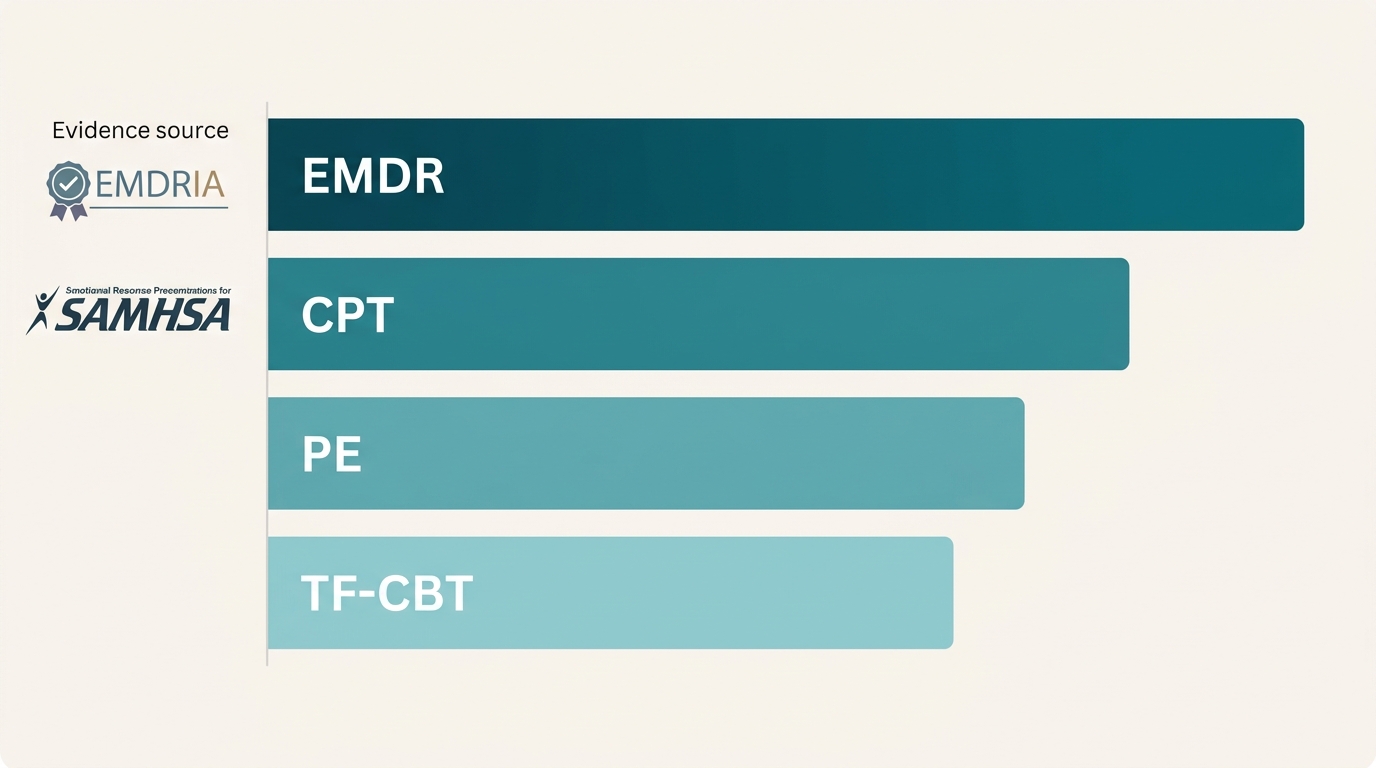
Om de effectiviteit van EMDR in perspectief te plaatsen, vergelijken we hieronder EMDR met andere traumagerichte therapieën op basis van gegevens van EMDRIA en SAMHSA.
| Therapie | Werkingsmechanisme | Wetenschappelijk bewijs bij verslaving | Gemiddelde duur | Beste geschikt voor |
|---|---|---|---|---|
| EMDR Therapie | Adaptieve informatieverwerking & bilaterale stimulatie | Sterk bewijs voor verslaving en trauma | 6-12 sessies | Complex trauma en verslavingsproblematiek |
| Cognitieve Verwerkingstherapie (CPT) | Herstructureren van disfunctionele gedachten | Matig bewijs | 12-16 sessies | PTSS zonder dissociatie |
| Langdurige Blootstelling (PE) | Herhaaldelijk confronteren met traumatische herinneringen | Beperkt bewijs bij verslaving | 8-15 sessies | Enkelvoudig trauma |
| Traumagerichte CGT (TF-CBT) | Cognitieve en gedragsmatige technieken | Groeiend bewijs bij comorbiditeit | 12-20 sessies | Kinderen en jongeren met trauma |
Hoewel elk van deze therapieën waardevol is, blijkt uit onderzoek van SAMHSA dat EMDR sterk bewijs levert voor de behandeling van verslaving en complex trauma. Bij Rosewood Recovery combineren we EMDR met holistische benaderingen zoals yoga en mindfulness, wat de verwerking ondersteunt en het algehele welzijn bevordert.
De onderstaande grafiek illustreert de gemiddelde sessieduur per therapievorm, met gebruik van EMDRIA- en SAMHSA-gegevens.
Recovery Begins Here voor iedereen die kiest voor herstel. Als je klaar bent om jouw reis te starten, neem dan contact op voor een consult. Begin your journey towards happiness and freedom – plan vandaag nog een consultgesprek. Resultaten kunnen variëren op basis van individuele patiëntfactoren en omstandigheden.
EMDR in de Praktijk bij Rosewood Recovery
At Rosewood Recovery, we implement EMDR therapy across all levels of care, providing clients with a seamless continuum of trauma-informed treatment. Our programs in Newtown, Pennsylvania, integrate eye movement desensitization and reprocessing (EMDR) into Partial Hospitalization, Intensive Outpatient, and General Outpatient services, ensuring each individual receives the right intensity of support for sustainable healing.
EMDR in Partial Hospitalization Programs
Our Partial Hospitalization Program (PHP) offers the highest level of outpatient structure, with clients attending therapy 5 to 6 days per week and a minimum of 20 hours of therapeutic programming. At this intensity, EMDR sessions are woven directly into the daily schedule, giving individuals immediate access to trauma processing when it is most needed. This integrated approach functions as a powerful crisis-intervention tool, helping clients stabilize severe post-traumatic stress symptoms while receiving comprehensive dual diagnosis treatment for co-occurring mental health conditions. The close supervision enables our clinical team to tailor the EMDR protocol based on real-time observations, ensuring each reprocessing session is both safe and effective. With an average duration of 2 to 4 weeks, PHP delivers a concentrated period of healing that lays a strong foundation for the next step in recovery.
The table below summarizes how EMDR is integrated across treatment levels at Rosewood Recovery.
EMDR Integratie per Behandelniveau
| Treatment Level | Session Frequency | EMDR Integration | Benefits | Average Duration |
|---|---|---|---|---|
| Partial Hospitalization Program (PHP) | 5-6 days per week | Intensive EMDR sessions integrated into daily program | Maximum support, crisis intervention | 2-4 weeks |
| Intensive Outpatient Program (IOP) | 3-5 days per week | Weekly EMDR sessions alongside group therapy | Balance between structure and autonomy | 6-8 weeks |
| General Outpatient Program (OP) | 1-2 times per week | EMDR as part of outpatient aftercare | Long-term trauma processing, flexibility | 3-6 months |
As clients stabilize, they can step down to the Intensive Outpatient Program, where the focus shifts toward applying trauma-processing skills in a more independent setting while maintaining robust clinical support.
EMDR in Intensive Outpatient Programs
In our Intensive Outpatient Program (IOP), individuals attend therapy 3 to 5 days per week, striking a balance that allows them to fulfill work or family obligations while receiving structured trauma treatment. Weekly EMDR sessions complement the ongoing group therapy and holistic practices, creating a multifaceted recovery experience. This trauma-informed design ensures that every program component—from psychoeducation to somatic exercises—reinforces emotional healing. Simultaneously, dual diagnosis treatment addresses underlying anxiety, depression, or other mental health challenges that often fuel addiction. The blend of intensive support and growing personal autonomy helps clients practice newly acquired coping strategies in real-world environments.
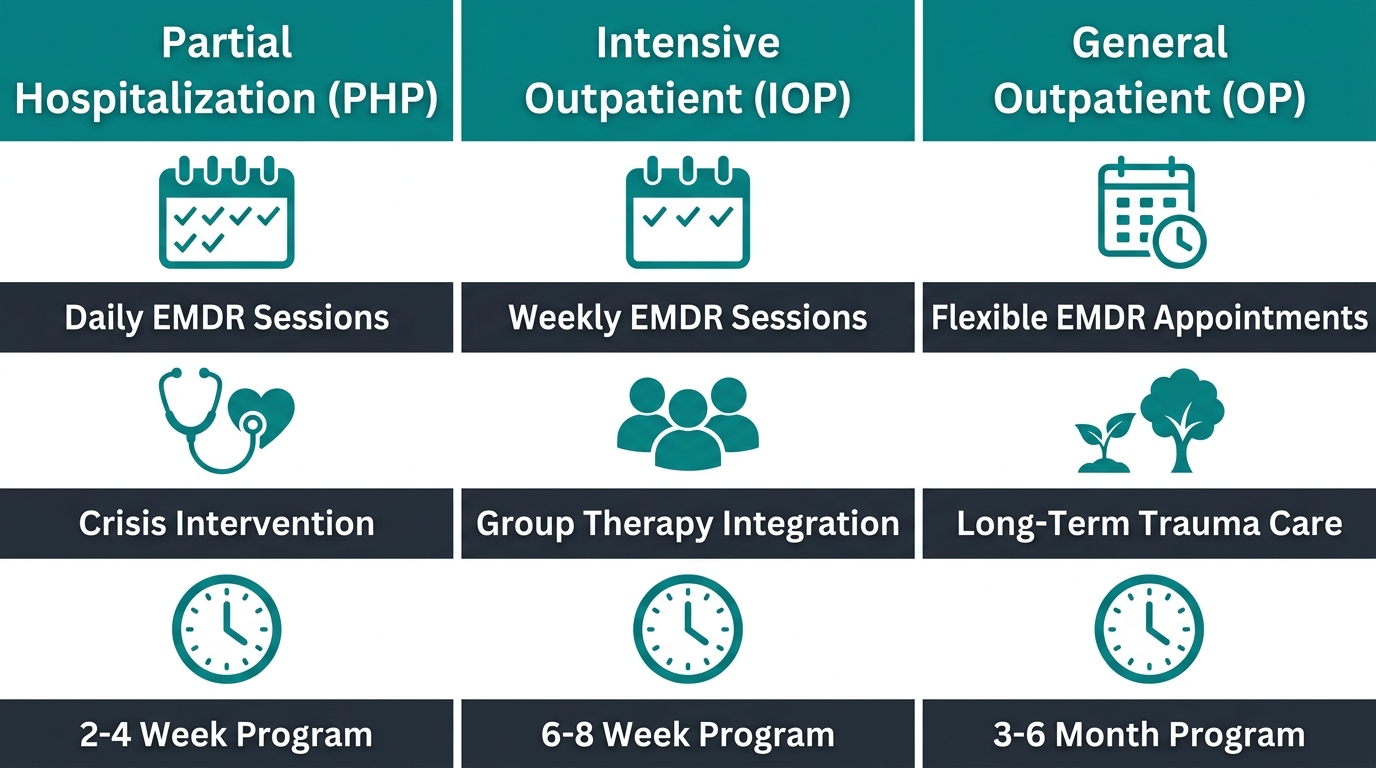
This visual overview illustrates how EMDR intensity decreases as clients gain greater stability, yet remains a cornerstone of trauma processing at every stage. The IOP typically spans 6 to 8 weeks, offering ample time for deeper therapeutic work while gradually preparing individuals for the final phase of outpatient care.
Trauma-Geïnformeerde Ambulante Zorg en Nazorg
As recovery progresses, our General Outpatient Program (OP) provides the flexibility essential for sustained trauma healing. Clients attend sessions 1 to 2 times per week, often for 3 to 6 months, allowing them to fully integrate the benefits of EMDR into everyday life. This level of care is grounded in trauma informed outpatient care, where each person works with a primary therapist to address lingering trauma triggers while building long-term resilience. For long-term trauma processing, our ambulante verslavingszorg in Newtown, Pennsylvania provides flexible EMDR sessions as part of the General Outpatient Program, extending support well beyond the initial treatment phase. Whether you attend sessions at our Newtown, Pennsylvania, location or through our outpatient services in Yardley, PA, the emphasis remains on personalized, compassionate care. The program incorporates holistic modalities such as yoga and mindfulness, reinforcing the mind-body connection essential for lasting recovery. Throughout this phase, we focus on relapse prevention and emotional regulation, empowering clients to maintain sobriety with confidence. If you’re ready to begin your journey towards happiness and freedom, schedule a consult call with our admissions team to discover how our trauma-informed approach can help you or a loved one. Results may vary based on individual patient factors and circumstances.
Onderzoek en Voordelen van EMDR bij Verslaving
Naast het begrijpen van hoe EMDR werkt, toont onderzoek duidelijk de voordelen aan voor herstel van verslaving. EMDR-therapie is een evidence-based behandeling die erkend wordt voor de aanpak van trauma en comorbide verslaving, volgens de EMDR International Association (EMDRIA). Uit meerdere klinische studies blijkt dat EMDR kan helpen bij het verminderen van trauma-gerelateerde triggers, het verlagen van het risico op terugval en het verbeteren van emotionele regulatie in de vroege herstelfase. Zo wijst een meta-analyse uit dat cliënten die EMDR ondergingen significant minder hunkering naar middelen ervoeren en een verbeterde stemming rapporteerden. De EMDRIA benadrukt dat EMDR een veilige en effectieve interventie is, die ook bij verslaving veelbelovende resultaten laat zien.
Deze bevindingen sluiten aan bij onze interne trendanalyse voor 2026, waaruit blijkt dat trauma-geïnformeerde, EMDR-gebaseerde zorg steeds vaker wordt ingezet in poliklinische verslavingsprogramma's. De opkomst van virtuele behandelopties en de groeiende erkenning van trauma als kernfactor in verslaving stimuleren de integratie van EMDR in ambulante zorg.
Bij Rosewood Recovery integreren we deze inzichten in onze behandelaanpak. Onze trauma informed outpatient care omvat EMDR als kerncomponent om cliënten te helpen bij het doorbreken van de cyclus van verslaving en onverwerkt trauma. EMDR-therapie blijkt aanzienlijke vermindering van angst en trauma-gerelateerde stress te kunnen bewerkstelligen, daarom bieden wij ook gespecialiseerde angsttherapie in Newtown Square als onderdeel van onze holistische aanpak. Door deze combinatie kunnen cliënten beter omgaan met triggers en hun veerkracht vergroten.
Omdat EMDR tegelijkertijd trauma en verslaving aanpakt, ondersteunt het effectief onze dual diagnosis behandeling, waarbij we comorbide stoornissen zoals angststoornis of depressie gelijktijdig behandelen. Deze simultane aanpak vermindert niet alleen de symptomen van PTSS, maar versterkt ook de motivatie om nuchter te blijven. Door traumagerichte interventies te combineren met verslavingsbehandeling, kunnen we de onderliggende oorzaken van middelenmisbruik aanpakken. Dit geïntegreerde model vergroot de kans op duurzame abstinentie en verbeterde kwaliteit van leven.
Deze voordelen maken EMDR tot een hoeksteen van onze trauma informed outpatient care — een behandelmethode die we met trots aanbieden bij Rosewood Recovery. Herstel begint hier; begin uw reis naar geluk en vrijheid. Individuele resultaten zijn niet gegarandeerd en hangen af van veel factoren, waaronder toewijding aan de behandeling.
Veelgestelde Vragen over EMDR Therapie
Now that you understand how EMDR works, here are answers to common questions.
What is EMDR therapy? EMDR therapy helps process traumatic memories through bilateral stimulation, reducing trauma symptoms. It is part of our holistic and somatic therapy.
How does EMDR help with addiction recovery? Since trauma often drives addiction, EMDR aids dual diagnosis treatment. Our trauma informed outpatient care integrates EMDR to support healing. Recovery Begins Here.
Is EMDR offered in your outpatient programs? Yes, EMDR therapy is offered at PHP, IOP, and OP levels within our holistic and somatic approach.
How do I start EMDR therapy at Rosewood Recovery? Schedule a consult call with our team to begin your journey towards happiness and freedom.
Where can I find additional support? For crisis support, visit SAMHSA nationale hulplijn bronnen or call the national helpline. Results may vary; consult with a healthcare provider for professional advice regarding treatment options.
Contact our team to schedule a consultation. We respect your privacy; our HIPAA privacy notice is available.
Jouw Pad naar Herstel met EMDR Therapie
EMDR therapy is an evidence-based trauma treatment that can help you heal trauma and address the underlying causes of addiction. At Rosewood Recovery in Newtown, Pennsylvania, we integrate EMDR into our Partial Hospitalization, Intensive Outpatient, and General Outpatient programs as part of our trauma informed outpatient care. Our holistic, somatic approach treats the whole person, supporting healing from substance use and co-occurring conditions. For dual diagnosis treatment, we address both addiction and mental health challenges simultaneously. Your recovery is personal, and we are here to support you at every stage. Take the first step: schedule a consult call and begin your journey towards happiness and freedom. Recovery Begins Here.


